Endtrace Platform Architecture
Structured AI-Integrated Learning, Execution, and Technical Support System
Operating Model
System Structure
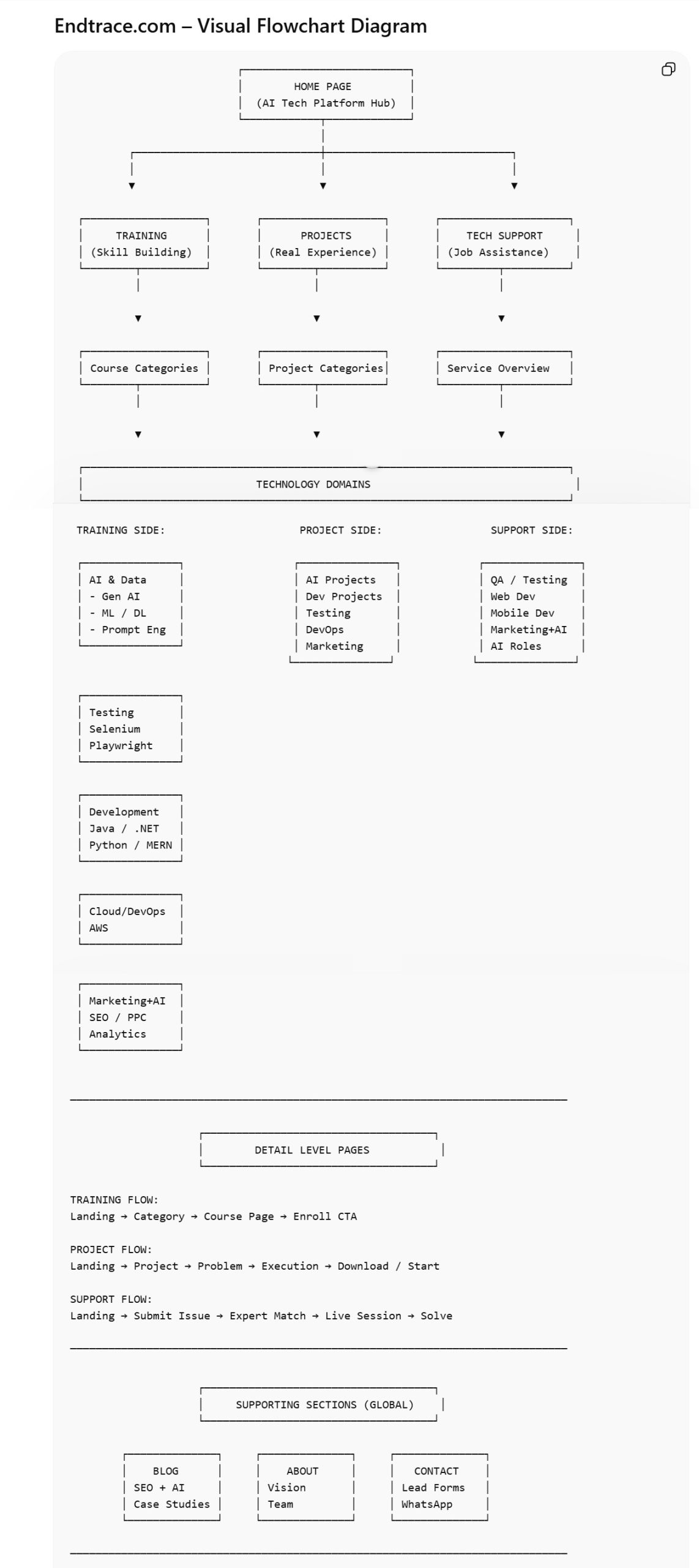
Endtrace is designed as a three-layer system that aligns learning with execution and real-world problem solving.
- Training: Structured skill acquisition
- Projects: Applied execution in real scenarios
- Technical Support: On-demand problem resolution
Functional Outcome
The platform reduces the gap between learning and employability by integrating practice and live support within the same ecosystem.
Training Layer: Skill Acquisition
Design Principle
Training is structured around enterprise-relevant technologies with integrated AI capabilities.
The focus is not on isolated tools but on role-based competency development.
Technology Coverage
| Domain | Technologies | AI Integration |
|---|---|---|
| Generative AI | Prompt Engineering, LLM Systems, AI Agents | Context design, agent workflows, retrieval systems |
| Software Development | Java, Python, .NET, MERN Stack | AI-assisted coding, copilots, automation |
| QA Automation | Selenium, Playwright, Cypress | AI-based test generation and validation |
| Cloud & DevOps | AWS, Azure, CI/CD | AI deployment pipelines, model integration |
| Digital Marketing | SEO, Google Ads, Analytics | AI-driven content, semantic search optimization |
| Data Systems | Machine Learning, Power BI | Predictive modeling, AI dashboards |
Delivery Model
- Instructor-led sessions by working professionals
- Live project integration within courses
- One-to-one mentorship
- Interview preparation and evaluation
Execution Layer: Real-Time Projects
Purpose
The project layer transforms theoretical understanding into applied capability through structured real-world problem scenarios.
Project Characteristics
- Based on real client-type problems
- Includes incomplete, ambiguous, and failure-prone scenarios
- Designed to simulate enterprise environments
- Focus on debugging, recovery, and optimization
Domains
- Generative AI applications and workflows
- Automation testing systems
- Full-stack application development
- Digital marketing execution with AI analytics
- Disaster recovery and system issue resolution
Outcome
Participants develop the ability to operate in non-ideal, real-world environments where predefined solutions are not available.
Support Layer: Technical Job Assistance
Function
The support layer provides real-time expert assistance for professionals working on live projects.
Service Model
- Availability on-demand
- Task-based engagement
- Pay-per-hour structure
- Direct interaction with experienced professionals
Coverage
- Software development and APIs
- Testing and automation frameworks
- Mobile and web applications
- Cloud and DevOps environments
- Digital marketing and analytics
- Generative AI systems
AI Integration Strategy
Enterprise Alignment
Enterprises are transitioning toward hybrid roles that combine traditional development with AI capabilities.
The platform reflects this shift by embedding AI into all technology domains.
Core Components
- AI-assisted development workflows
- Prompt engineering and context systems
- AI agent development frameworks
- Integration with cloud AI services
- Embedding AI into existing applications
Market Alignment
Observed Shift
Demand is moving away from isolated AI specialists toward developers who can integrate AI into existing systems.
Positioning
The platform addresses this shift by focusing on hybrid skill development across software engineering, AI systems, and operational environments.
Content Layer: AI-Optimized Blog System
Purpose
The blog layer functions as a structured acquisition and knowledge distribution system.
It is designed to attract, educate, and convert users across different stages of intent
while maintaining compatibility with both search engines and AI-driven response systems.
Content Design Model
Each technology domain includes dedicated blog content authored and structured by subject matter specialists.
Content aligns with three primary search intent categories:
- Informational: Concept explanation, foundational knowledge, problem awareness
- Commercial: Tool comparisons, solution evaluation, workflow understanding
- Transactional: Implementation guides, decision-stage content, action-oriented queries
Search and AI Alignment
Content is engineered to perform across both traditional search engines and AI-based systems.
This includes compatibility with long-form, goal-oriented queries typically used in AI interfaces.
- Optimized for semantic search and entity-based indexing
- Structured to respond to long-form prompts in AI systems
- Designed for visibility in AI-generated summaries and overviews
- Supports discoverability across platforms such as conversational AI and search engines
Content Structure
Each blog article follows a consistent semantic and structural framework to improve readability,
search engine indexing, and AI interpretability across platforms.
- Hierarchical headings (H1–H4) for logical content segmentation and AI chunking
- TOFU (awareness), MOFU (consideration), BOFU (decision) layered content flow
- Context-driven explanations with real-world use cases
- Branding optimization through consistent tone, terminology, and domain authority signals
- Strategic internal linking connecting blogs with training, projects, and support layers
- Semantic keyword optimization aligned with user intent and entity-based search
- Integrated FAQs using structured
<details>and<summary>for AI extraction - Clear call-to-action elements for lead capture and user progression
- Schema markup integration (Article, FAQ, HowTo) for enhanced SEO and AI visibility
Technical Implementation
| Component | Function |
|---|---|
| Semantic HTML | Improves content parsing for search engines and AI models |
| Schema Markup | Enhances structured data visibility and rich results |
| FAQ Structures | Supports direct answer extraction by AI systems |
| Internal Linking | Connects blog content with training, projects, and support layers |
| Intent Mapping | Aligns content with user search behavior and decision stages |
System Role within Platform
The blog layer connects external discovery channels with internal platform offerings.
It acts as an entry point for users and distributes them across training, project execution,
and technical support based on their intent and stage.
Outcome
This structured content system enables consistent organic traffic generation,
improves visibility in AI-generated responses, and supports user progression
from information discovery to active engagement.
Structured Clarifications
Is this a training platform or a services platform?
It operates as both. Training builds capability, projects validate it, and support applies it in real environments.
How is this different from standard online learning platforms?
Standard platforms separate learning from execution. This system integrates them within a continuous workflow.
Who uses the platform?
Students, early-career professionals, and experienced engineers requiring support in active projects.
Real-World Projects on SEO, Google Ads (PPC), Digital Marketing , AI Included
Get hands-on project experience in Generative AI, QA automation Testing, Machine Learning, Python development, Digital Marketing, and more. Designed for students, beginners, and professionals to practice real industry workflows.
Need Help with a Project or Practice?
Tell us what you’re trying to build or learn. Get guidance based on real-world workflows.
Real Projects • Practical Guidance • Industry-Based Support